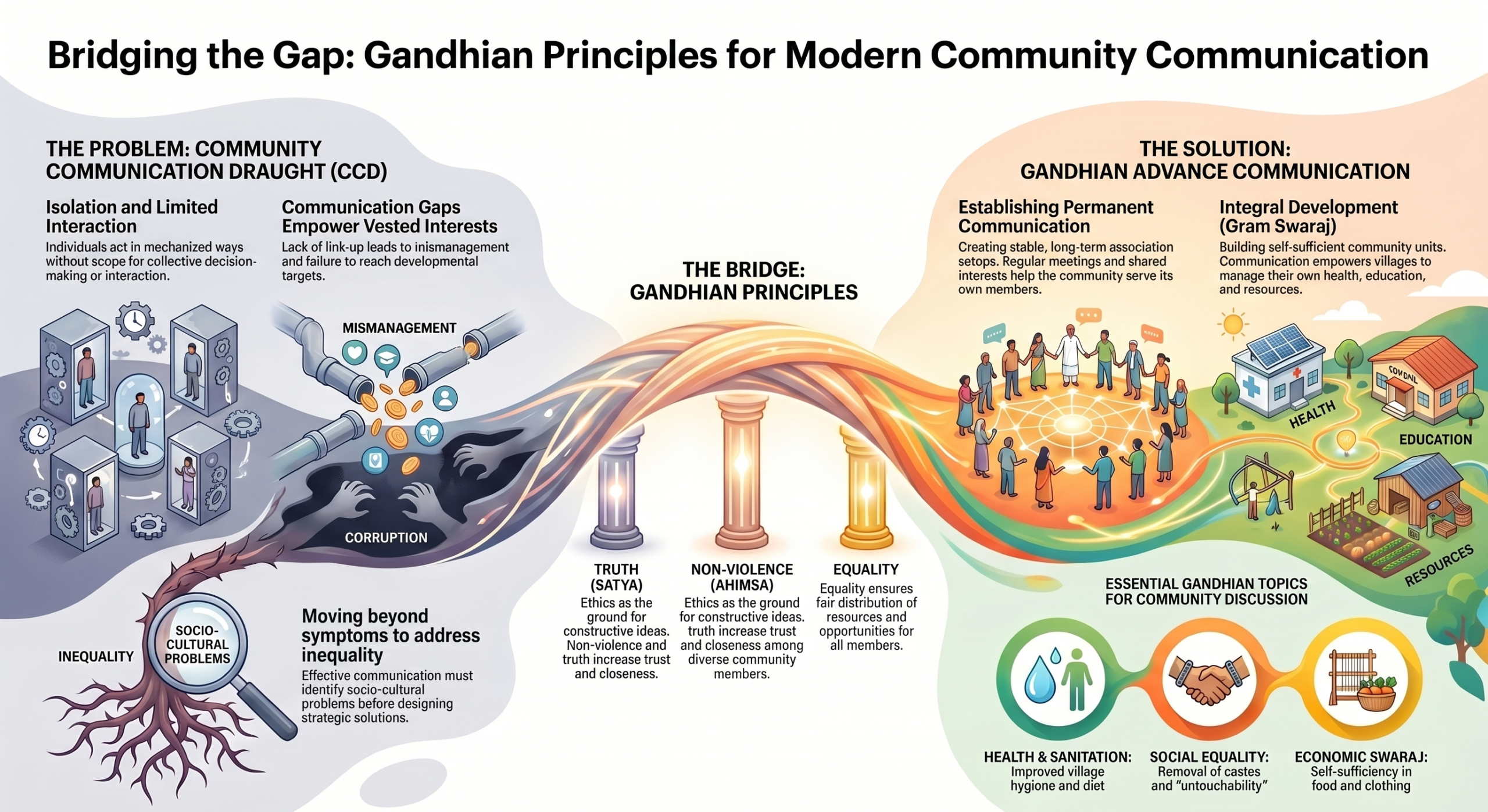
In our ever-changing world, the true measure of good governance and integral development is how well we involve every member of our community. Yet, despite living in an era of hyper-connectivity, many communities suffer from a severe lack of meaningful interaction. How can we bridge this gap? Surprisingly, the answers might lie in the philosophies of Mahatma Gandhi.
While Gandhi never claimed to be a communication theorist, his life and principles offer a “hidden treasure” of inspiration for modern community building. Here is how we can apply Gandhian communication theory to empower our communities today.
The Problem: Community Communication Draught (CCD)
 Have you ever felt like people in your neighborhood are living in their own isolated bubbles? This phenomenon is known as a “Community Communication Draught” (CCD). It occurs when community members spend their time focused on personal activities without interacting or discussing common problems to make collective decisions.
This “draught” is dangerous. When people feel helpless and fail to communicate, a gap is created that provides ample scope for corruption, mismanagement, and failed developmental plans. To overcome this, communities need to actively rebuild their communication links.
The Solution: Advance Community Communication (ACC)
To combat CCD, we need “Advance Community Communication” (ACC). This concept involves using both traditional gathering places (like tea stalls or folk music events) and modern technological tools (like smartphones, television, and radio) to create a connecting link among community members.
However, simply having the technology isn’t enough. For ACC to be truly effective and foster sustainable development, it must be infused with the essence of Gandhian philosophy.
Lessons from Gandhi’s Playbook
Gandhi’s time in South Africa serves as a masterclass in community communication. After facing severe racial discrimination—such as being asked to remove his turban in court and being thrown out of a first-class train compartment—Gandhi realized that the root of the problem required collective action. Here is how he built a communication strategy that we can emulate today:
1. Tap into Existing Networks Before starting a new movement, Gandhi identified the existing communication channels. In Pretoria, he partnered with Sheth Tyeb Haji Khan Muhammad, an influential figure among the Indian community, to connect with everyone. Blog takeaway: Don’t reinvent the wheel. Use the existing social networks, community leaders, and popular platforms in your area to start conversations.
2. Make Communication Permanent Gandhi proposed creating a permanent association to protect the interests of the community. Regular meetings and a stable communication setup ensure that members remain connected over a long period, which increases the strength and stability of the community.
3. Anchor Communication in Truth and Ahimsa (Non-violence) For Gandhi, “Truth is God”. Truthfulness in a community’s communication system restores trust, minimizes litigation, and unites people of different beliefs and backgrounds. Furthermore, Ahimsa (non-violence) must be practiced in both thought and speech. By avoiding violent or aggressive speech, communities can build harmony and generate constructive ideas for development.
4. Embrace Transparency and Flexibility Gandhi was an “open book” who advocated for free speech and transparency, believing that openness increases closeness among community members. He also championed flexibility—the willingness to yield to a sound argument and adapt to create social reality.
What Should Communities Talk About?
Even with the best communication platforms, communities often struggle with what to discuss. Gandhi’s vision of “Village Swaraj” (village self-sufficiency) provides a fantastic blueprint. He emphasized that communities should prioritize conversations around:
- Sanitation and Health
- Diet and Education
- Cultural Heritage
- Avoiding alcohol and drugs
- Developing communal unity
By focusing on these core issues, every member can work towards ensuring their community is self-sufficient and that everyone’s basic needs are met.
Conclusion
Adopting Gandhian philosophy in our modern communication strategies is not just about looking backward; it is about finding the best path forward. By combining modern tools like social networks with the timeless principles of truth, non-violence, transparency, and healthy human relationships, we can turn isolated individuals into a powerful, unified community.
It is in our hands to use the essence of these experiences to think beyond the basic needs of our community and achieve true, collective development.