Dr Alekha Sachidananda Nayak, Dr Pradosh Kumar Rath
Abstract— This article expands the scope of communication studies beyond existing theories and models by discussing the catalytic behaviour of communication elements. The catalytic nature of certain chemical substances is well-known: without participating in a chemical reaction themselves, their presence increases the reaction rate. Communication elements mimic this catalytic nature within the communication process. It is essential to analyse the catalytic nature of elements such as the medium.
Index Terms—Catalysis, communication, communication elements, Diamond Model, meaning of message, medium, message.
—————————— ◆ ——————————
1. INTRODUCTION
Communication plays a vital role in the 21st century across various disciplines. “The term ‘communication’ has many different meanings and definitions, but the central idea is a process of increased commonality or sharing between participants, based on sending and receiving a message” (McQuail, 2012, p. 552). “To generate communication, we need five basic elements: source, message, channel, receiver, and effect of the message. Who says what? With what purpose? To whom? In what situation? By what means? With what effect?” (Narula, 2011, p. 5). In 1949, Shannon and Weaver introduced the concept of noise in the communication process. “In the process of transmission, certain distortions are added to the signal which are not part of the message sent by the source, and we call this NOISE” (Narula, 2011, p. 48). As communication deals with commonality and participation, feedback is also included in communication models. Hence, there are seven essential elements: source, message, channel, receiver, feedback, effect, and noise. The medium is one of the most important elements. In the second half of the 20th century, the medium became a major subject of discussion among scholars. Theorists Harold Innis and Marshall McLuhan gained popularity with concepts like “The Bias of Communication” and “The Medium is the Message”, respectively. To understand communication in greater detail, one must discuss the catalytic behaviour of these elements. These elements, such as the medium, act as catalysts by disseminating information more rapidly and increasing acceptability without changing the core meaning of the message.
2 McLuhan, Medium, Message and Communication
2.1 McLuhan, Medium, Message
 Before discussing the catalytic behaviour of communication elements, let us begin with the concept of the medium proposed by theorist Herbert Marshall McLuhan. “Beginning with Innis’s idea about the impact of the printing press on information monopolies, McLuhan’s medium theory states that any advanced society is shaped by the various media technologies that are available to it” (Laughey, 2008, p. 33). New media technologies like radio, TV, and the Internet play a significant role in constructing and changing the structure of society.
The content of the media message is secondary; media technologies themselves play an influential role in society. “For the ‘message’ of any medium or technology is the change in scale, pace, or pattern that it introduces into human affairs” (McLuhan, 1946, p. 8). The message contained in any medium cannot be separated from the medium itself or its consequences for society. “Therefore, ‘the medium is the message’ because the medium shapes and controls the scale and form of human association and action. The content or uses of such media are as diverse as they are ineffectual in shaping the form of human association” (McLuhan, 1946, p. 9).McLuhan argued that the medium is the message because when a message is associated with a specific medium, it exerts a specific impact on the society or the receiver. The medium itself assumes the form of a message. “This fact, characteristic of all media, means that the ‘content’ of any medium is always another medium. The content of writing is speech, just as the written word is the content of print, and print is the content of the telegraph” (McLuhan, 1946, p. 8).
The medium influences the impact of the message. Generally, it is assumed that the message is responsible for any effect on the receiver. However, according to McLuhan, the medium or technology is responsible for changes in human society rather than the message itself. One cannot separate the medium from the message; the value or impact of the message is secondary to that of the medium or technique. Therefore, it can be argued that the medium is the message..
 2.2 Medium, message and its catalytic behaviour
Ironically, it can be argued that the medium is the message because it functions as a message to influence human society. We shall now examine the relationship between the medium, the message, and their catalytic behaviour from various perspectives.
Although the medium impacts the message, it does not fundamentally alter the meaning of a pure message. Even if a message is presented differently across various media, its original meaning remains intact. If the meaning of a message changes due to a particular medium, that message should be considered a different message entirely. For example, the meaning of “Gandhian Nonviolence” remains constant regardless of whether it is transmitted via newspaper, radio, television, or public speech.
As Dan Laughey says in his book ‘Key Themes in Media Theory’ regarding McLuhan’s medium concept:(The message contained in any medium is inseparable from the medium’s human consequences that matter most. Therefore, “The medium is the message”) (Laughey, 2008, p. 33)
The communication process consists of five primary elements: source, message, channel, receiver, and feedback. If we accept the aforementioned logic, we could argue that messages associated with any communication element are inseparable from their most significant human consequences. Thus, the source, channel, receiver, and feedback could also be considered “messages.”
Similar to McLuhan’s concept of the medium, other elements cannot be separated from the message. These elements play a significant role in the communication process and influence human society by performing the influential work of a message. This raises the question: why is only the medium considered the message? Elements such as the source, receiver, or feedback also influence society in association with the message, though their impact may vary depending on the situation or conditions.
The medium and other elements speed up the process of communication, helping to send messages to a larger audience and influencing them with greater intensity without changing the original meaning. Therefore, rather than saying the medium is the message, it is more accurate to describe it as a catalyst in the communication process.
3 Catalysts in communication
3.1 Catalyst
In chemistry, a catalyst is any substance that increases the rate of a reaction without being consumed (Encyclopædia Britannica, n.d.). Figuratively, it is something that precipitates activity between two or more persons or forces without being affected itself (Dictionary.com, n.d.).
3.2 Communication Catalyst
Communication catalysts are factors that participate in the communication process to enhance the impact or effect of a message and its rate of diffusion without diluting its core meaning.Examples include: supplemental entertaining content alongside information, the choice of medium (radio, TV, print), graphic design, presentation style, the sender (who speaks the message), and the receiver (who receives the message). All of these may act as catalysts. Frequently, the source plays a significant role in determining the impact of a message on the receiver; in such cases, the sender is considered a catalyst.Mass communication is defined as “the process by which a person, group of people, or large organisation creates a message and transmits it through some type of medium to a large, anonymous, heterogeneous audience.” (Pearce, 2009, p. 624)According to this definition, mass communication is only possible through mass media that can transmit messages to large, anonymous, and heterogeneous audiences. This potential for dissemination is the catalytic nature of mass media; without altering the message’s meaning, the medium rapidly transmits it to a vast number of people.
To understand the catalytic nature of a communication element, it is necessary to examine its relationship with the message and the message’s meaning.
3.3 Nature of the catalyst in communication
The nature of a catalyst refers to its behaviour or role within the communication process. Elements such as the sender or medium act catalytically by enhancing importance, acceptance, clarity, and the rate of dissemination.
Importance: The presence of a particular element, such as a specific sender or medium, can increase the perceived importance of a message.
Acceptance: The audience’s acceptance of a message is influenced by elements such as the medium, the sender, or the design of the message.
Clarity: Message clarity is achieved through appropriate medium selection and presentation. For instance, a political statement from a party leader is often perceived as clearer than one from a standard worker. Thus, clarity develops through the catalytic impact of communication elements.
Rate of Dissemination: The rate of transmission is influenced by catalytic agents like the medium. Advanced communication technology allows messages to be sent more rapidly without changing their core meaning.
4 Meaning and objective of the message in communication
 4.1 Meaning and message
A message is defined as “usually a short communication transmitted by words, signals, or other means from one person, station or group to another” (The Free Dictionary, n.d.). The meaning is the essence of the message. When an activity, arrangement of symbols, or visual content has a specific meaning, it constitutes a message. “A message is a set of codes that has its own meaning for the communicator and receiver. The code could be verbal, nonverbal or written” (Aggarwal & Gupta, 2001, p. 16).
Before developing a message, the sender conceives an idea or meaning. This meaning is then encoded into a message using available signs and symbols, adapted for the medium of transmission. Upon reaching the receiver, the message is decoded back into meaning.
Throughout this process, the “meaning” is influenced by elements such as the message, medium, and factors in coding and decoding. The meaning of a message is controlled by all elements of the communication process; the sender, receiver, and medium all possess the potential to influence it.
4.2 Objective of a communication process
The objective of communication is for the message to reach the target audience. This objective includes the number and types of receivers who receive the message.The sender intends for the message’s specific meaning to be understood by the receiver as intended. If the message reaches the audience with minimal distortion, the predetermined objective of communication is fulfilled.If the message reaches the audience with minimal disturbing impact on the message, then it will fulfil the predetermined objective of communication.
5 Process of Communication with Catalytic Nature
5.1 Elements of the communication process with a catalytic nature
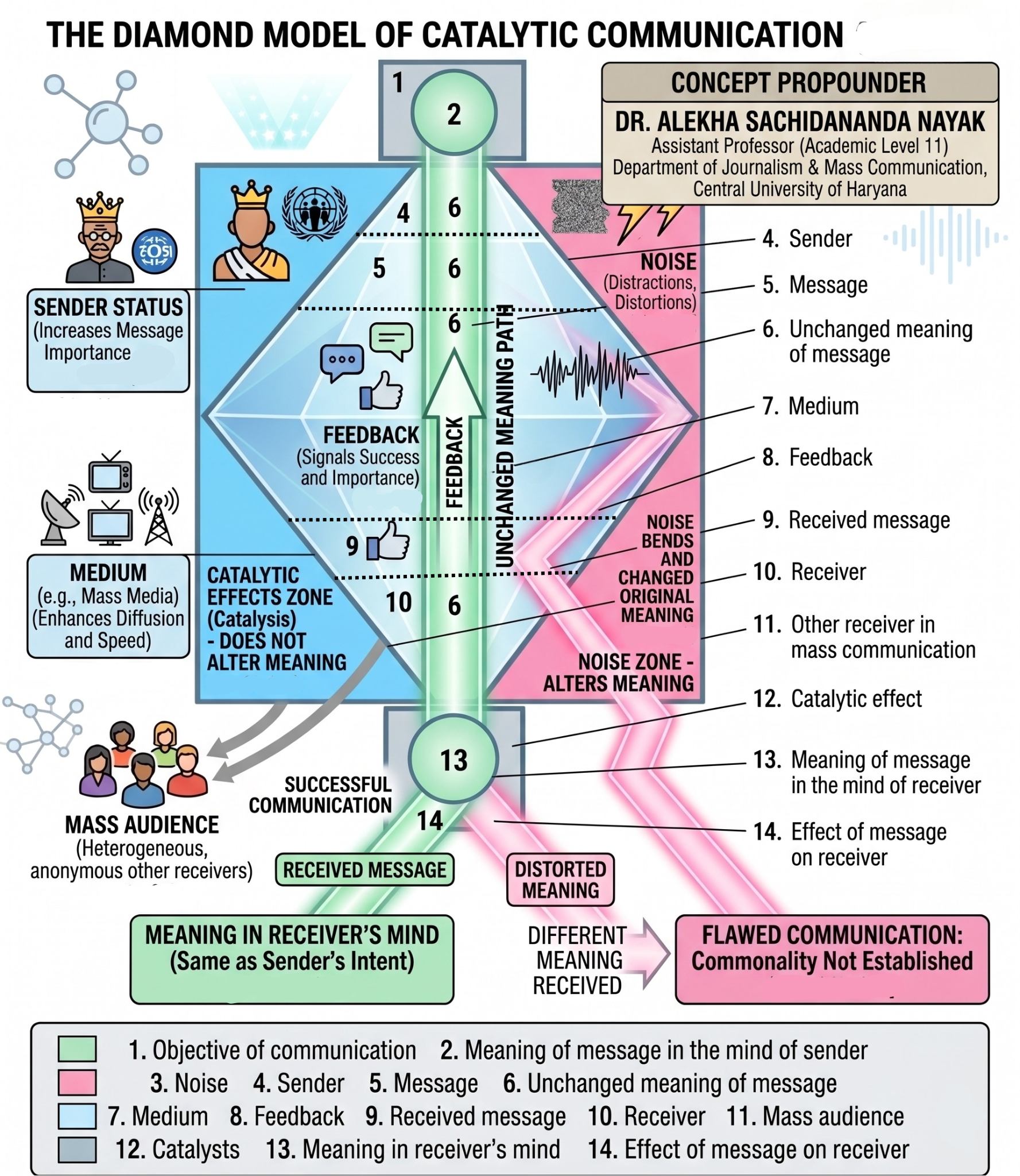
To fully understand the communication process and its catalytic nature, it is essential to consider the 10 core elements: meaning, objective, sender, catalyst, message, medium, noise, receiver, effect, and feedback.
The cutting edges of the Diamond Model show how the value of the initial idea, meaning, and objective of the message are influenced by various catalysts and noise.
The accompanying figure explains the position and function of these elements. This communication model, named the Diamond Model due to its shape, provides information about the various elements of communication and their roles. Key components in this model include the meaning of a message, the objective of the message, and the catalytic behaviour of the elements. Before constructing any message, the sender begins the communication process by generating an idea, concept, or “meaning” for the message. Meaning is defined as ‘something that one wishes to convey, especially by language’ (The Free Dictionary, n.d.). The sender always designs a plan or blueprint for the message, determining what he/she wants to convey.
Alongside the meaning, the sender also decides the message’s objective based on the current requirements. The sender considers who the receivers will be, their number, and the message’s anticipated impact. The message’s objective determines its structure and the medium through which it will be transmitted.
Following the meaning and objective, the “sender” develops the “message”, adapting it to the available coding elements and communication medium. The meaning and objective, therefore, influence the development of the original message to be sent to the receiver. In this situation, the sender may act as a catalyst by increasing the message’s importance. For instance, when an important person (like Gandhi or a government spokesperson) or a major organisation (like a prominent news agency) acts as the sender, the message gains more importance compared to one sent by a common person. Here, the sender plays a catalytic role by increasing the message’s importance without changing its meaning.
The message then reaches the receiver through a channel or “medium”. The medium’s catalytic nature allows it to transmit the message more rapidly to a large number of people without altering its original meaning. Because of this speed and reach, print, radio, TV, and new communication media play a central role in the field of communication. As they help to transmit messages at lightning speed across the globe, they increase their importance and impact on the audience.
The receiver gets the coded message from the “channel” and decodes it into a specific meaning. The receiver can also sometimes act as a catalyst to increase the message’s importance. For example, if a prime minister or king listens to a school student’s problem or opinion about Swachh Bharat Abhiyan (Campaign Clean India is a national-level campaign by the Government of India covering 4041 statutory towns to clean the streets, roads and infrastructure of the country. This campaign was officially launched on 2 October 2014 at Rajghat, New Delhi. The receiver’s status attracts news makers, increasing the message’s prominence.
Throughout the communication process, the message is influenced by numerous catalysts at various stages. The catalytic impact of each communication element acts differently depending on the situation. Ultimately, the message is decoded by the receiver into a meaning that results in an “effect”.Based on the receiver’s understanding (meaning), the receiver sends a reverse message to the sender, known as “feedback”. Feedback can also act as a catalyst; for example, a TV program episode that garners more feedback or SMS responses is often considered the most important or successful episode.
Any distraction to the meaning of the message during the communication process is known as “noise”. Noise is defined as ‘In the process of transmission, certain distractions are added to the signal which are not part of the message sent by the source, and we call this noise.’ (Narula, 2011, p. 48) Noise influences, bends, or changes the original meaning of the message.
Elements like the medium, sender, receiver, or any treatment given to the message are known as a “catalyst”. These factors participate in the communication process to improve the message’s impact/effect and its rate of diffusion without diluting the original meaning.
The cutting edge of diamond shows how the value of the initial idea or the meaning & objective of the message gets influenced by different catalysts and noise.
6 Criticism and Explanation
Criticism 1: How can we say the meaning of a message cannot be changed by the medium? Because when we see a message on television, we give more importance to that message. We accept television lessons more gladly than those of our parents.
Explanation 1: Whether any messages we get from television or from our parent meaning of the message is the same, but has a different impact because television acts as a catalyst. Television or the internet can send a message at a faster rate and have a greater impact on them.
Criticism 2: The cutting edge of the diamond model shows how the meaning of the message gets influenced by different catalysts. Then how can we say meaning cannot be changed?
Explanation 2: The sender’s original meaning remains constant. However, if the sender loses control over other communication elements, fails to encode the message properly, cannot manage noise, or if the receiver fails to decode correctly, the resulting meaning will differ from the sender’s intent. This is defined as flawed communication because the commonality between the sender and receiver is not established. This process is illustrated by the “cutting edges” in the Diamond Model.
7 Conclusion
There is no doubt about the critical importance of communication in the 21st century. To understand communication more profoundly, it is essential to further study the catalytic behaviour of communication elements. Investigating how the meaning of a message and the objectives of communication are influenced by various catalysts will provide communication scholars with a more comprehensive understanding of the field.
References
Aggarwal, V. B., & Gupta, V. S. (2001). Handbook of Journalism and Mass Communication. Concept Publishing Company.
Dictionary.com. (n.d.). Catalyst. Retrieved May 26, 2026, from http://dictionary.reference.com/browse/catalystEncyclopædia Britannica. (n.d.). Catalyst. Retrieved May 26, 2026, from http://www.britannica.com/EBchecked/topic/99128/catalyst
Laughey, D. (2008). Key Themes in Media Theory. Rawat Publication.
McLuhan, M. (1946). Understanding Media: The Extension of Man. MIT Press.
McQuail, D. (2012). McQuail’s Mass Communication Theory. SAGE Publications India Pvt Ltd.
Narula, U. (2011). Mass Communication Theory and Practice. Har-Anand Publication Pvt Ltd.
Pearce, K. J. (2009). Media and Mass Communication Theories. In Encyclopedia of Communication Theory. SAGE Publications.
The Free Dictionary. (n.d.). Meaning. Retrieved May 26, 2026, from http://www.thefreedictionary.com/Meaning.
The Free Dictionary. (n.d.). Message. Retrieved May 26, 2026, fromhttp://www.thefreedictionary.com/message
Powered By EmbedPress