When you watch the evening news, do you ever feel like you are just being talked at? For a long time, television media has been criticized for being a one-way street. However, in a truly democratic society, the media—often called the fourth pillar of democracy—cannot function without the active participation of the people.
Public feedback isn’t just a nice-to-have; it is the very soul of democratic media practice. But how well are today’s television networks actually listening to us? An analytical study of Indian news and current affairs channels sheds light on the present trends and the roadblocks keeping your voice from the newsroom.

The Evolution of the Audience’s Voice
Historically, journalists viewed the “letter to the editor” as the golden standard for public participation, allowing readers to share ideas or call out unethical practices. Today, the landscape has completely transformed. We are no longer limited to postal letters.
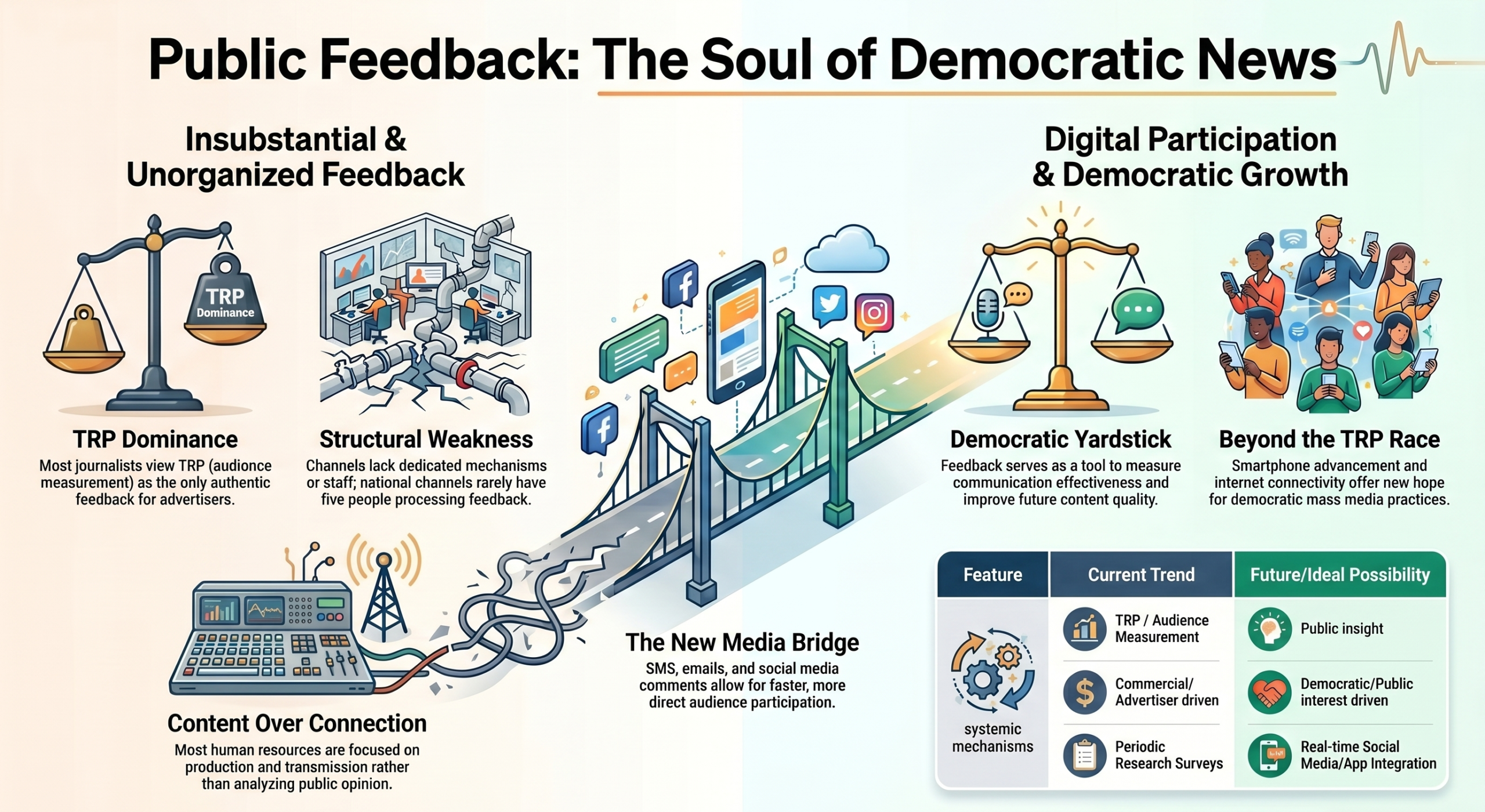
In the era of new media, our voices can be heard instantly. We can tweet our reactions, leave comments on online articles, write our own blogs, or send an SMS directly to a channel. Advancements in digital technology and cheap internet connectivity have blown the doors wide open for audiences to share their thoughts from their personal mobile devices, anytime and anywhere.
The Roadblock: The “TRP Trap”
Despite these technological leaps, the feedback mechanism in television remains surprisingly insubstantial and unorganized. Why? Because the industry is heavily reliant on TRP (Target Rating Point).
For many news channels, TRP is considered the only “real” and authentic feedback because higher ratings directly attract advertisers. This creates a dangerous “TRP Trap”:
- A Lack of Resources: Many networks dedicate their human resources strictly to content production, leaving barely anyone to collect or process actual public feedback.
- Selective Listening: Channels might close a program if the TRP drops, but they are incredibly hesitant to change a highly-rated, popular program even if it receives negative public feedback.
- The Urban vs. Rural Divide: Networks often face the challenge of satisfying diverse audiences—for instance, balancing the demand for “cheap entertainment” in some rural areas against the desire for “hard news” in urban centers.
Why Real Feedback Matters
Feedback is the yardstick that measures how effective communication truly is. If a media organization only cares about ratings, it risks becoming a threat to democracy by failing to reflect actual public needs and opinions.
However, there is hope. Studies show that the most popular and fastest-growing channels are actually the ones taking public feedback seriously. These forward-thinking networks use dedicated teams to collect, store, and analyze audience comments. By reviewing this data, reporters and editors can better understand the public interest, shape future programming, and significantly boost the credibility of their organization.
The Path Forward
For media to remain a true democratic institution, it must evolve. It is time for news channels to look beyond the frantic race for TRP and use new media platforms to bridge the gap between the news desk and the audience.
As viewers, our role is equally important. The next time you watch a news broadcast, don’t just be a passive consumer. Send that email, leave that comment, and participate in the dialogue. A democratic media system requires your voice just as much as it requires the prime-time news hour.