DR ALEKHA SACHIDANANDA NAYAK
Assistant Professor (Academic Level 11)
Department of Journalism & Mass Communication, Central University of Haryana
Abstract
Democracy is fundamentally defined as government by the people, for the people. Active participation is the cornerstone of a functional democratic system. Historically, the human intellect has consistently sought to leverage communication tools to facilitate this engagement. Mass media, often referred to as the fourth pillar of democracy, plays a crucial role in this process. In the contemporary era, digital computing, the internet, and satellite-based communication have significantly expanded the horizon for public participation. These platforms facilitate the convergence of traditional media into a unified, versatile digital space. The democratic nature of new media—characterized by effortless replication, rapid transmission, universal connectivity, and inherent flexibility—attracts an ever-growing user base, becoming an essential lens through which we perceive the world. Furthermore, initiatives such as the “Digital India Mission” prioritize the digitalization of executive, legislative, and judicial processes, thereby reinforcing democratic values. Current trends suggest that the future of human society is inextricably linked to digital communication. Consequently, it is imperative to analyze the trajectory of digital interaction and its implications for mankind. New media is increasingly assuming the form of a societal superstructure, interconnecting various human units into a complex symbiotic phenomenon. This article examines the structure, effects, and democratic significance of this emerging digital superstructure.
Keywords: democracy, digital communication, new media, universal communication, and participatory communication.
 Introduction
The efficacy of democracy is intrinsically tied to the level of public participation. In his 1863 Gettysburg Address, Abraham Lincoln famously defined democracy as “government of the people, by the people, for the people” (Simon 177), emphasizing the necessity of citizen involvement in governance. In a robust democracy, the role of the citizen extends beyond the act of voting; individuals must be well-informed to critique, suggest, and contribute to national progress. For the voice of the populace to reach the government—and for rights and policies to reach the citizens—a transparent and well-managed communication framework is required. Thus, effective communication is an indispensable tool for modern governance.
Mahatma Gandhi posited that “Democracy must in essence, therefore, mean the art and science of mobilizing the entire physical, economic and spiritual resources of all the various sections of the people in the service of the common good of all” (Dalton 144). Gandhi advocated for the utilization of all societal mechanisms for the collective benefit. From local discourse to advanced mass communication, every platform should serve the democratic objective of informing and educating the public. Without such information, a government cannot truly reflect the will of its people. As noted by Dutta (1), a democratic system reaches its full potential only when there is broad participation, which is impossible if the masses remain uninformed about critical issues. Knowledge empowers citizens to select capable leaders and plan for a constructive future.
History demonstrates that mass media, beginning with the printing press, played a pivotal role in decolonization and the global establishment of democratic ideals. Radio, television, and print media have historically supported global development and connectivity. However, media can occasionally be co-opted by elite interests. Unwin (2) notes that governments and global corporations have often used technology to exert power over individuals. Despite these challenges, mass media remains the fourth pillar of democracy, a role that is being refined by the advent of new media. The flexibility of digital platforms allows for the convergence of traditional media into a single, influential medium that is profoundly reshaping human society and democratic systems.
Democracy and New media
New media occupies a central role in contemporary democracy. Rushkoff (53) argues that the true promise of network-enhanced democracy lies in encouraging broader participation through interactive digital forms. Beyond providing education and entertainment, new media empowers citizens to participate in the formulation and execution of government policy. It offers platforms for public discourse, allowing individuals to engage with leaders and access information regardless of geographic location. Furthermore, it facilitates the aggregation of public opinion, offering “an open and inclusive discussion space which allows expression of oppositional positions” (Democratic Progress Institute 11), thereby fostering democratic engagement.
While some critics highlight that digital media can be controlled by corporate interests, its potential for democratic practice is widely recognized. The Government of India has prioritized digitalization through the “Digital India” program, aiming to transform the nation into a “digitally empowered society and knowledge economy” (Digital India). This initiative seeks to enhance transparency and improve public service delivery through three key pillars: digital infrastructure as a utility, governance on demand, and the digital empowerment of all citizens (Digital India).
Digital democracy does not replace democratic philosophy; rather, it makes it more practical by overcoming physical barriers. Hacker (1) defines digital democracy as a collection of attempts to practice democracy without the constraints of time and space using Information and Communication Technology (ICT). Similarly, Sahu (105) describes e-democracy as the structures and processes encompassing electronic interaction between the elected government and the electorate, emphasizing the use of technology to engage citizens in decision-making.
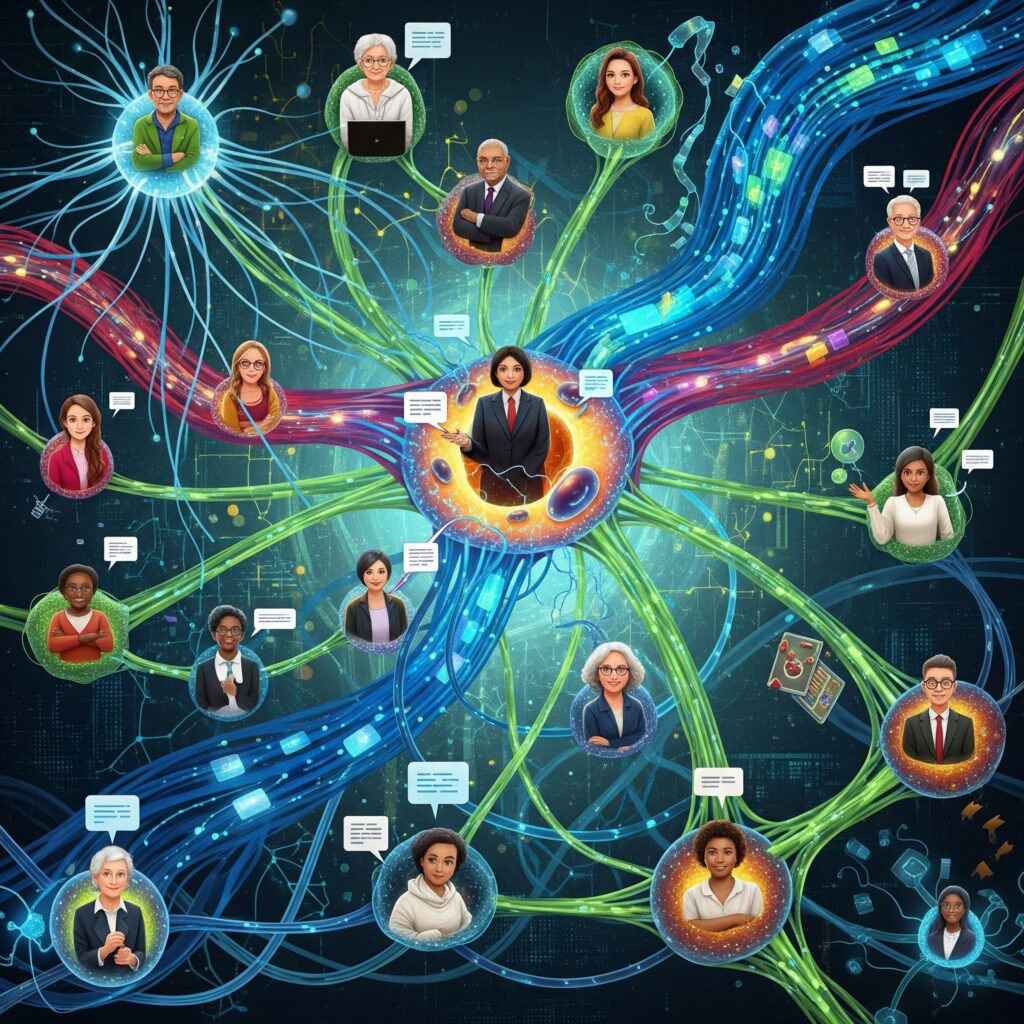
New media and Symbiotic Phenomena
Traditionally, media has been understood as the means of expressing ideas via specialized institutions such as the press, cinema, or advertising (Lister 11). Today, however, the term “new media” predominantly refers to digital, internet-based platforms. Much like the printing press was once a revolutionary “new” medium, the computer and internet-based ecosystem represent the contemporary standard for efficient information dissemination. This digital medium facilitates the easy production, editing, storage, and transmission of messages at an economical cost, encompassing blogs, online journalism, and various forms of interactive public expression.
The defining characteristic of modern new media is its digital, cross-linked nature, allowing information to be easily processed, retrieved, and searched (Logan 7). Digital interaction has become an integral part of daily life, with mobile devices and computers providing constant global connectivity. Mesaros (50) notes that information posted online has a universal reach with no parallel in the offline world. Social networking sites are increasingly integrated into this digital fabric, where collective server memory provides vast space for user-generated content. Both large organizations and individual users contribute to this burgeoning digital repository.
Using personal computing and modern telecommunications, individuals can transmit messages across the globe instantaneously (Harasim 6). The proliferation of social media, blogs, and electronic journals has led to a rapid increase in user-generated content that is publicly accessible. This interconnectedness diminishes the sense of physical distance; as Jenkins (17) observes, people may live miles apart yet remain deeply integrated through their digital activities—a phenomenon described as “tele-cocooning.” Consequently, the synergy between digital infrastructure and human activity has birthed a complex symbiotic association.
A symbiotic relationship is one in which diverse entities exist in close association, often to their mutual benefit (Margulis 140). Through digital interaction, individuals worldwide are united into a cohesive unit that benefits the whole.
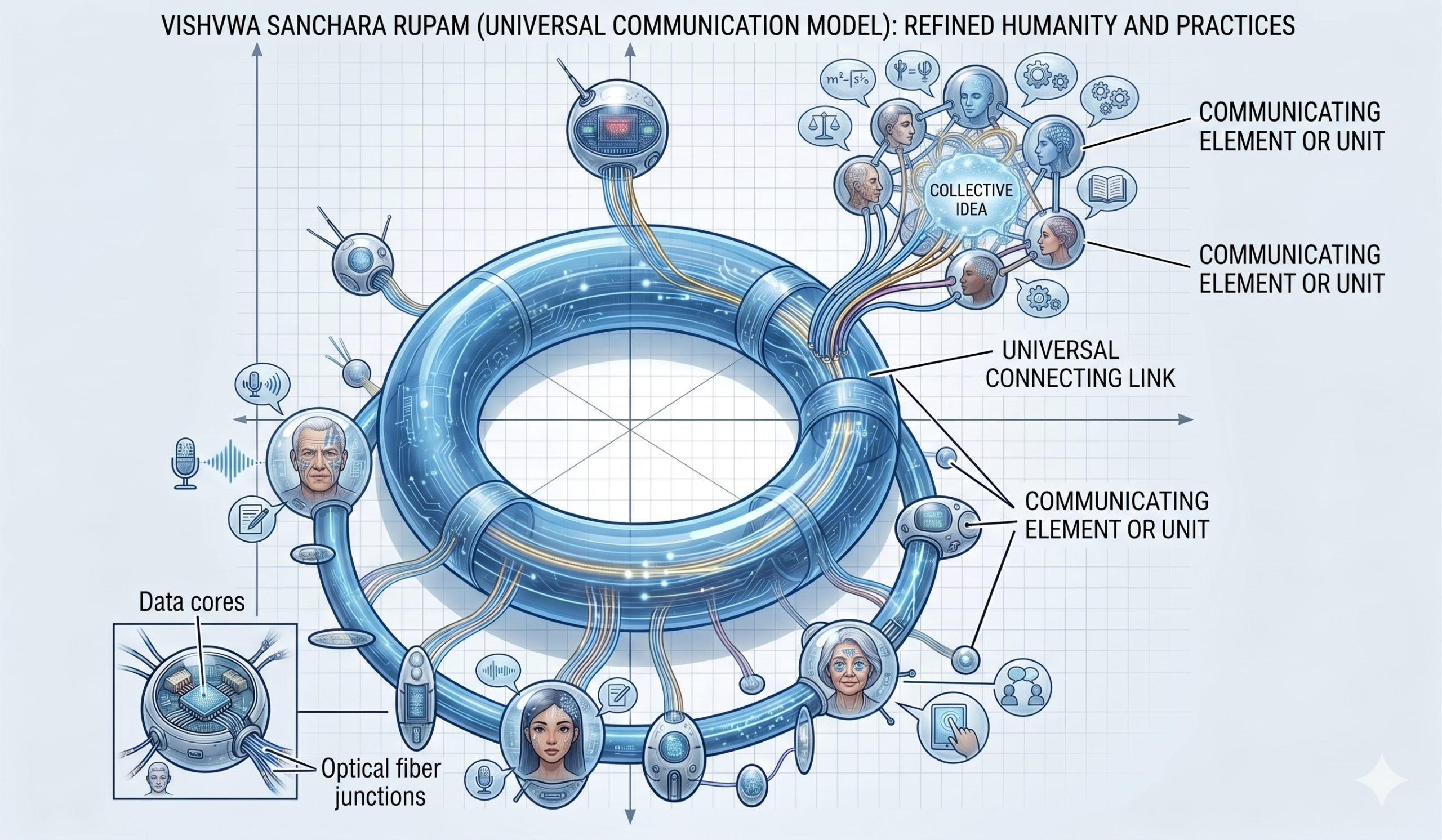
To better understand this phenomenon, we must consider the Universal Communication Model, or “Vishwa Sanchar Rupam.” This model provides a framework for the communication infrastructure that enables symbiotic associations among the global population.
Vishwa Sanchara Rupam (Universal Communication Model)
The name of the model is derived from the Sanskrit “Vishwa” (universe) and “Sanchar” (communication), inspired by the “Vishwarupa” concept in the Bhagavad Gita. Rather than focusing on isolated interactions between individuals, this model seeks to explain the universal communication process as a holistic system. It illustrates how individuals, often unknowingly, become integral parts of a global communication network through their everyday digital activities.
Traditional media have long facilitated human contact for societal growth, but as Harasim (3) notes, global networks and international computer-mediated communication have fundamentally expanded the capacity for connection. This flexible digital environment allows for the emergence of a dynamic, interconnected universal community.
In this global framework, communication occurs continuously among various “communicating elements.” These elements are active units—such as individuals, groups, or organizations—with the capacity to generate and interpret messages. A “message” in this context encompasses any meaningful activity, including text, audio, visuals, or art. These units often coalesce to form larger entities that collectively function as senders or receivers within the universal system.
The functions of these elements are diverse, ranging from personal updates on social media to professional correspondence. However, the resulting content often reaches a much wider audience than originally intended and may be reinterpreted over time. For instance, a video captured for personal use might serve as a primary source for journalism or a catalyst for social movements. Much of this data collection occurs unconsciously. Individuals may be captured in the background of news reports or public photos without their awareness. This massive daily influx of data provides the democratic authorities with valuable insights into the condition and interests of the masses. Through the symbiotic association of humans and digital media, data is autonomously collected and processed, with the individual contributor often remaining unaware of their role in the larger universal communication process.
Communicating elements frequently possess limited control over the trajectory of their messages. One cannot fully predict who will receive a message or how long it will persist in the digital realm. A social media comment or an email could potentially remain accessible for centuries, serving as raw data for future researchers attempting to understand 21st-century human behavior. This longevity ensures that personal contributions have an enduring impact on the universal record.
Angela (48) observes that new media ensures social and cultural identities are no longer solely defined by physical presence. The digital footprint of the average person is expanding, leading to a state where individuals increasingly identify themselves through their online presence.
This evolution bolsters the activity of universal communication, as individuals reinforce the global superstructure through their digital identities.
This paradigm raises significant questions: What is the relative position of an individual unit within this vast universe? Who monitors and manages content in this decentralized system? How is the staggering volume of daily messages transmitted, stored, and interpreted over the long term? Answering these requires a holistic understanding of the universal communication process.
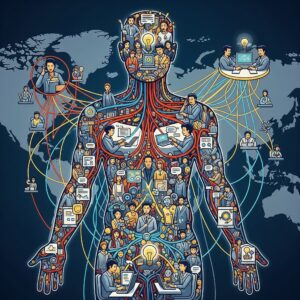
The collective physical and intellectual potential of all communicating elements forms a gargantuan universal communication system. This system leverages all available technologies—satellites, the internet, and broadcast media—alongside human cognitive faculties. Each individual functions like a cell within a giant organism; while each cell performs a specific task, they all contribute to the vitality and function of a single, unified body.
When one writes an article or a blog post, they are not merely communicating with a specific audience but are contributing to the universal communication system. This system preserves and disseminates that contribution, allowing it to be interpreted by countless others for years to come. In this regard, there are no practical limits to universal communication activity.
Structure of Vishwa Sanchar Rupam. The symbiotic superstructure is the result of uniting global communication hardware and software. Satellites, mobile networks, computers, and the human brain constitute the hardware of this system. Organizations and storage infrastructures also play a vital role. Conversely, communication protocols, software applications, and human intelligence represent the system’s software components.
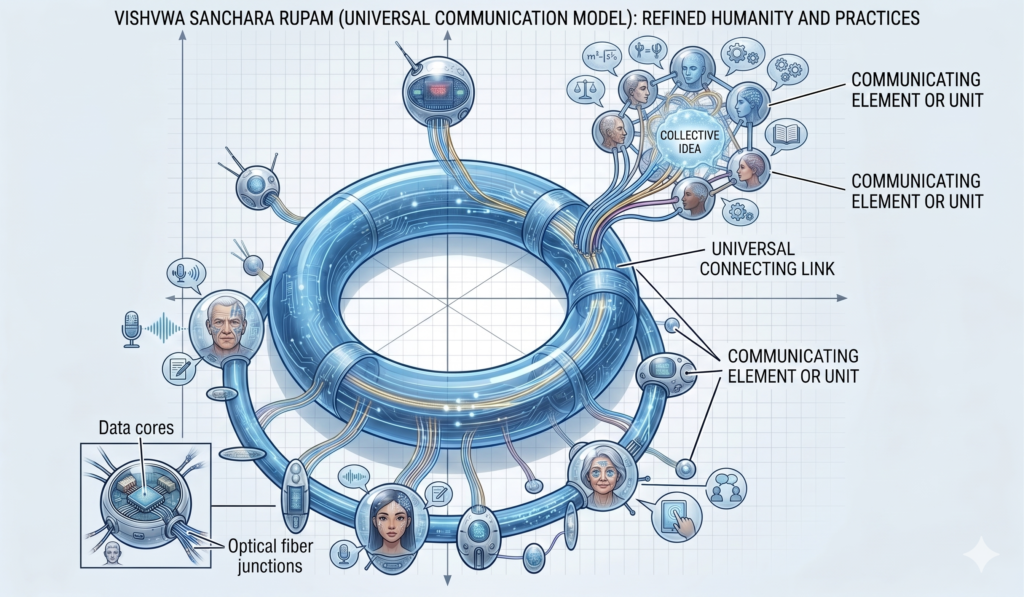
Figure 1 illustrates the association of individual communication units with the universal superstructure, fostering a symbiotic relationship.
While some units are more deeply integrated than others, all contribute to the superstructure. As suggested by McLuhan and Innis, media act as extensions of the human mind (Littlejohn 337). Advanced communication minimizes the spatial and temporal constraints on human connection, creating a fertile ground for democracy to flourish through symbiotic association.
Vishwa Sanchar Rupam and Democracy. The universal communication system is dynamic, evolving alongside technological advancements and human perception. To maximize democratic potential, individuals must develop a conscious understanding of their role within this system. While many currently participate in democracy through digital means unconsciously, the goal should be to transform this into a productive, conscious democratic engagement.
As technology and our understanding of communication mature, the global population can connect more effectively, acting as a single entity. This integration has the potential to mitigate internal conflicts; just as the human body responds collectively to an injury, an advanced universal communication structure could enable the global community to solve democratic challenges rapidly. Every individual, perceiving a collective problem as their own, would contribute to a swift resolution.
Conclusion
This study attempts to conceptualize the universal communication process through the lens of democratic values. It illustrates how various communication activities and infrastructures naturally unite to form a superstructure that supports democratic functions. Incentivizing the use of modern technology and new media is a crucial step toward achieving a “true democracy.” Within this superstructure, the distinction between separate individuals blurs, replaced by the realization of an interrelated and interdependent symbiotic association.
Works Cited
1. Pilch Ortega, Angela, and Barbara Schrottner, editors. Transnational Spaces and Regional Localization: Social Networks, Border Regions and Local-Global Relations. Waxmann Verlag GmbH, 2012.
2. Bhagavad Gita. Translated by Sri Swami Sivananda, Divine Life Society Publication, 2000, www.dlshq.org.
3. Dalton, Dennis, editor. Mahatma Gandhi: Selected Political Writings. Hackett Publishing, 1996.
4. Democratic Progress Institute. “New Media and the Development of Democracy.” Democratic Progress Institute, 2012.
5. Digital India. “Official Site of Department of Electronics & Information Technology, Government of India.” 16 June 2015,
www.digitalindia.gov.in.
6. Dutta, Soumya. “Social Responsibility of Media and Indian Democracy.” Global Media Journal, Indian ed., summer issue, June 2011.
7. Hacker, Kenneth L., and Jan van Dijk. Digital Democracy: Issues of Theory and Practice. SAGE, 2000.
8. Harasim, Linda Marie. “Global Networks: An Introduction.” Global Networks: Computers and International Communication, edited by Linda Marie Harasim, Electronic Publishing Service, 1993.
9. Jenkins, Henry. Convergence Culture: Where Old and New Media Collide. New York University Press, 2006.
10. Lister, Martin, et al. New Media: A Critical Introduction. 2nd ed., Routledge, 2009. 11. Littlejohn, Stephen W., and Karen A. Foss. Theories of Human Communication. 10th ed., Waveland Press, 2011. 12. Logan, Robert K. Understanding New Media: Extending Marshall McLuhan. Peter Lang, 2010.
13. Margulis, Lynn. “Symbiosis and Evolution.” Readings in Biology and Man, edited by Miguel A. Santos, MSS Information Corporation, 1973. 14. Mesaros, Claudiu, editor. Knowledge Communication: Transparency, Democracy, Global Governance. Editura Universitatii de Vest, 2011. 15. Rushkoff, Douglas. Open Source Democracy: How Online Communication is Changing Offline Politics. Demos, 2003.
16. Sahu, Ganesh P., editor. E-Government Development and Diffusion: Inhibitors and Facilitators of Digital Democracy. IGI Global, 2010.
17. Simon, Thomas W. Democracy and Social Injustice: Law, Politics, and Philosophy. Rowman & Littlefield, 1995.
18. Unwin, Tim. “Social Media and Democracy: Critical Reflections.” Commonwealth Parliamentary Conference, Sept. 2012.